Oil-Cooled EV Motor Protection with VS-RDW Shaft Grounding
|
Oil-cooled traction motors improve thermal management, but immersion can disrupt shaft grounding contact. Learn how Volsun VS-RDW rings are engineered for reliable motor protection in EV oil-chamber applications.
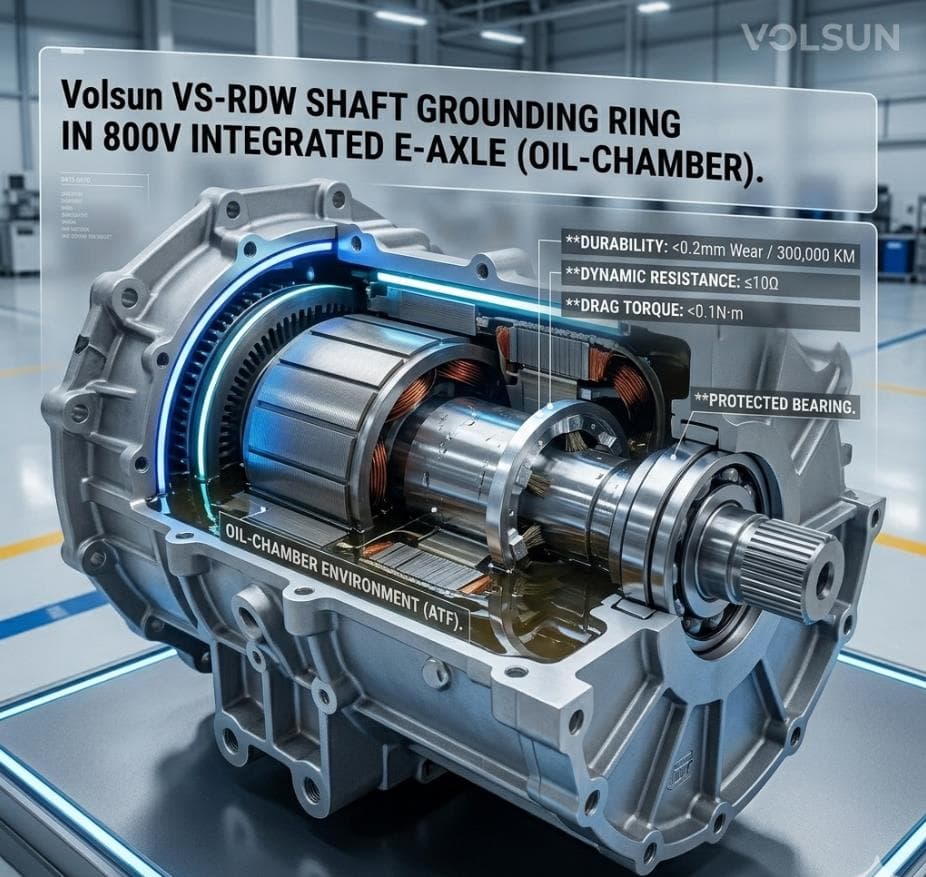
As electric drive systems move toward higher power density, oil-cooled motors are increasingly used in integrated e-axles. Direct contact between automatic transmission fluid (ATF) and internal components can improve thermal management, but it also introduces a design trade-off: the same cooling oil that removes heat can act as an electrical insulator and interfere with the grounding path intended to protect motor bearings.
In an oil-chamber motor, conventional grounding devices may lose consistent shaft contact when an oil film forms between conductive fibers and the rotating shaft. Volsun addresses this challenge with its VS-RDW shaft grounding ring series, designed to maintain a stable ground path under oil spray, immersion, and high-speed operating conditions.
Engineering for the Oil Film Challenge
The primary obstacle in an oil-cooled motor is the dielectric behavior of the cooling lubricant. At high shaft speeds, a thin oil layer can build up between grounding fibers and the metal shaft. If fiber stiffness or bundle density is insufficient, shaft voltage may remain on the rotor and eventually discharge through the bearing lubricant film, leading to electrical discharge machining (EDM) damage.
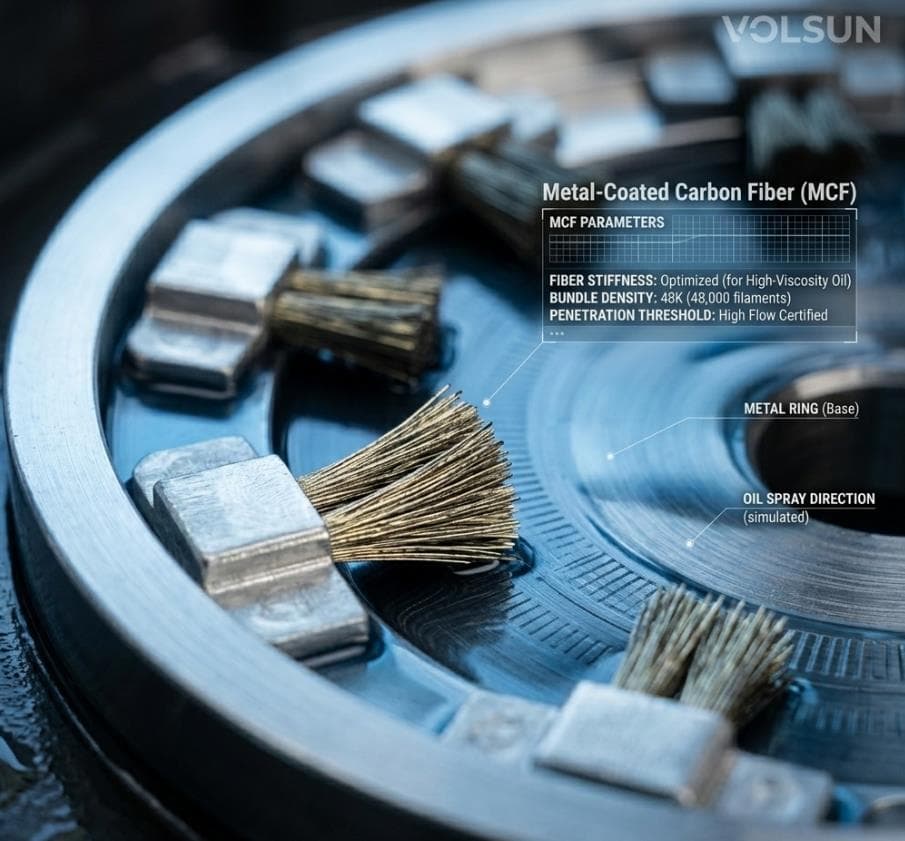
Volsun VS-RDW Series (3rd generation) grounding rings use metal-coated carbon fiber (MCF) technology. By tuning fiber stiffness and bundle density—in configurations up to 48K—the microfibers are designed to maintain physical and electrical contact with the shaft under high-flow oil spray or full immersion.
Durability in Oil-Chamber Service
Volsun R&D work, conducted with leading research partners, indicates that oil-chamber environments can support long fiber service life when the ring is correctly specified. In addition to removing heat from the motor, the cooling oil can provide mild lubrication at the fiber-shaft interface compared with fully dry chamber conditions.
In oil-cooled applications, test data show wear of less than 0.2 mm over 300,000 km under defined operating conditions. This durability target helps OEM and fleet engineering teams align grounding hardware life with bearing service expectations in high-mileage EV platforms.
Low Resistance and Low Drag Torque
Efficiency remains a key design constraint in traction motor development. The VS-RDW series is designed for low drag torque (typically below 0.1 N·m) so the grounding function does not materially penalize vehicle range. Electrical performance is maintained with dynamic contact resistance of 10 Ω or less over the intended service life.
VS-RDW for High-Voltage EV Platforms
With a compact 4 mm profile and a modular laser-welded structure that can reduce overall system cost by approximately 20%, the VS-RDW series is suited to 800 V high-voltage electric drive architectures where space, weight, and assembly efficiency are tightly controlled.
FAQ: Grounding Rings in Oil-Chamber Motors
- Does cooling oil type (ATF) affect grounding ring performance?
Yes. Oil viscosity and flow conditions can influence the threshold at which an oil film interrupts contact. Volsun evaluates compatibility with customer-specified lubricants and calibrates fiber stiffness for the intended oil flow rate and motor speed.
- Is the VS-RDW series suitable for both dry and wet motor chambers?
Yes. Fiber parameters can be customized for water-cooled dry chambers or oil-cooled wet chambers to balance wear resistance, contact stability, and electrical performance.
- Can fiber wear contaminate cooling oil or affect gears?
Wear over a 300,000 km service interval is expected to be minimal. Any particles generated are soft and small enough that they are unlikely to damage hardened gears or block precision oil filters when the system is correctly designed.
- How does the 3rd-generation RDW design reduce cost?
The modular structure integrates the fiber module with the aluminum base through laser welding. This reduces part count and assembly time compared with older multi-piece designs, supporting a cost reduction of more than 20% in many applications.
- How is the grounding ring retained under vibration in mining or off-road EV applications?
Interference-fit (press-fit) installation helps keep the ring seated in the motor housing and maintain a stable ground path under high mechanical vibration and shock loads.
Related technical resources: What Causes VFD Bearing Failure?
Solid Shaft Grounding Ring (RD/RDW)
Conclusion
Oil-cooled EV motors place new demands on shaft grounding design. Thermal management benefits from direct oil contact must be balanced against the risk of interrupted ground paths and bearing-level electrical damage. For application reviews, shaft diameter inputs, or project-specific specifications, contact the Volsun team through the inquiry channel on this site.
Need sizing help?
Send motor nameplate data and shaft diameter - we respond within 24 hours.
Contact & RFQ